According to calculations by the Armenian Patriarchate of Constantinople, in 1913, there were 1,914,620 Armenians living within the Ottoman Empire. On the other hand, estimates from the U.S. Embassy in Constantinople stated that 2.4 million Ottoman citizens belonged to the Armenian millet. Other sources speak of over 2,000,000 Armenians. Most calculations did not account for the Catholic, Protestant, and Greek Orthodox Armenians.
To calculate the Armenian population more accurately prior to the genocide, the following factors must also be taken into account:
- The 150,000–200,000 Armenians who sought refuge in Russian-controlled Caucasus during the periods of 1828–1829, 1877–1878, and 1894–1896.
- The 10,000–25,000 Armenians who were killed during the first phase of the Eastern Question crisis (1877–1879).
- The 150,000–300,000 Armenians who were massacred during the Hamidian massacres (1894–1896), by order of Sultan Abdul Hamid II.
- Approximately 100,000 Armenians who emigrated in the late 19th century to Europe, America, and the Middle East.
- The 25,000–30,000 Armenians who were murdered in Adana in 1909 during bloody riots.
- The tens of thousands who were forcibly converted to Islam under violent or coercive circumstances during the aforementioned massacres.
According to reports by the U.S. State Department, the Near East Relief, and the British Embassy in Constantinople, by 1921 there were 817,873 Armenian refugees and displaced persons. Other sources estimate 500,000–600,000. The discrepancies are partly due to the large number of refugees who died from hunger and hardship during displacement.
In 1922, during the Asia Minor Catastrophe, thousands of Armenians were killed. Following the destruction, about 131,000 Armenians were displaced from Asia Minor. Of these, 25,000–30,000 were from Smyrna, while the rest were genocide survivors who had fled from the eastern provinces and Cilicia to the coastal areas of Asia Minor.
The Armenian community of Constantinople was comparatively less affected. In 1921, it numbered about 150,000 individuals.
After the genocide, at least 350,000 Armenians fled to the newly independent Republic of Armenia. Of these, 150,000–180,000 died from starvation, disease, and the extremely difficult living conditions. In 1918, the Ottoman army, taking advantage of the Russian withdrawal, advanced into the Caucasus and northern Persia, killing at least 100,000 Armenians, including 10,000–30,000 in Baku with the assistance of Azerbaijani irregulars.
In 1920, during the Turkish–Soviet invasion of Armenia, at least 60,000 civilians were killed. Other sources claim up to 250,000 victims, although many were not Ottoman Armenians. Additionally, several thousand Armenians were killed in Cilicia in 1921 during the Franco-Turkish War.
In Summary:
- Over 1,500,000 Armenians were victims of the Genocide.
- 600,000–817,873 were survivors or refugees, many of whom later died due to starvation and disease.
- About 150,000 remained in Constantinople in 1921.
Thus, in 1914, the Armenian population in the Ottoman Empire likely exceeded 2,200,000. This number was probably even higher in earlier decades if we take into account the Hamidian massacres and massive waves of emigration.
The conclusion is clear: the Armenian Genocide was one of the greatest catastrophes of modern history, the consequences of which still weigh heavily on the Armenian nation today.
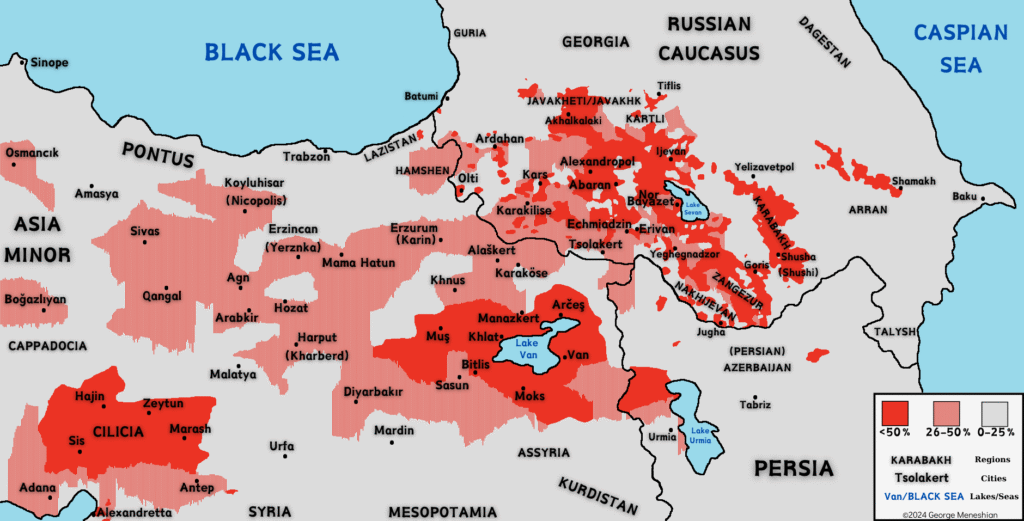
Map source: Meneshian, G., 2024. Vioi Parallēloi; Ellēnes kai Armenioi, apo ta millet sta ethnē-kratē [Parallel Lives? Greeks and Armenians, From Millets to Nation States]. Athens: Armenika, p. 158.
Sources
Akçam, T., 2006. A Shameful Act: The Armenian Genocide and the Question of Turkish Responsibility. New York: Metropolitan Books.
Akçam, T., 2012. The Young Turks’ Crime against Humanity: The Armenian Genocide and Ethnic Cleansing in the Ottoman Empire. Princeton/Oxford: Princeton University Press.
Bijak, J. & Lubman, S., 2016. ‘The Disputed Numbers: In Search of the Demographic Basis for Studies of Armenian Population Losses, 1915–1923’. In A. Demirdjian, ed. The Armenian Genocide Legacy. Basingstoke: Palgrave Macmillan, pp. 26–43.
Bloxham, D., 2005. The Great Game of Genocide: Imperialism, Nationalism, and the Destruction of the Ottoman Armenians. Oxford: Oxford University Press.
Bournoutian, G. A., 1980. ‘The Population of Persian Armenia Prior to and Immediately Following its Annexation to the Russian Empire: 1826-1832’. The Wilson Center.
Cox, S. S., 1893. Diversions of a Diplomat in Turkey. New York: Charles L. Webster & Co.
Dadrian, V. N., 1995. The History of the Armenian Genocide: Ethnic Conflict from the Balkans to Anatolia to the Caucasus. Providence, RI: Berghahn Books.
De Waal, T., 2015. Great Catastrophe: Armenians and Turks in the Shadow of Genocide. Oxford/New York: Oxford University Press.
Hovannisian, R. G., 1967. Armenia on the Road to Independence, 1918. Berkeley, CA: University of California Press.
Hovannisian, R. G., 1971. The Republic of Armenia: The First Year, 1918-1919. Berkeley, CA: University of California Press.
Karayan, S. Y., 2010. ‘The Fate of the Armenians in the Ottoman Empire and Republican Turkey: From 1828 to 2000’. Massis Weekly, 30(14), pp. 6-8.
Kerr, S. E., 1973. The Lions of Marash: Personal Experiences with American Near East Relief, 1919-1922. New York: State University of New York.
Kévorkian, R. H. & Paboudjian, P. B., 1992. Les Arméniens: dans l’Empire ottoman, à la veille du genocide. Paris: Arhis.
Bolsajian, M., 2018. ‘The Armenian Diaspora: Migration and its Influence on Identity and Politics’. Global Societies Journal, 6, pp. 29-40.
Morris, B. & Ze’evi, D., 2019. The Thirty-Year Genocide: Turkey’s Destruction of its Christian Minorities, 1894-1924. Cambridge, MA: Harvard University Press.
Toynbee, A. J., 1916. The Treatment of Armenians in the Ottoman Empire: Documents presented to Viscount Grey of Fallodon. London: Sir Joseph Causton and Sons Ltd.
Walker, C. J., 1980. Armenia: The Survival of a Nation. London: Croom Helm.